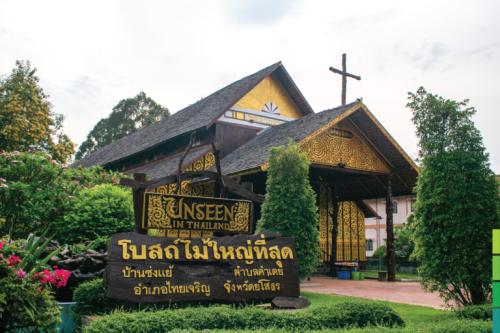
Ban Song Yae Christian Church is located in Thai Charoen district, Yasothon. There is a history in 1908 that there were 5 families who fled from different places to live in this area, they fled for the same reason, which was accused being ghouls and they were therefore attacked and drove away.
It is the 4th church, planned for construction in 1936. Villagers gathered wood and built it in 1947. The shape of the church was built in Thai art style, width 16 meters, length 57 meters. It is the largest in Thailand, using 80,000 wooden planks as roofing boards, using 360 columns of different sizes, mostly wooden poles. The pillars in the middle row are the largest and longest with 260 trees, more than 10 meters high from the ground. The floor planks are of red wood and large Takhian wood. The wooden bench can hold over a thousand people.
The church bell has a diameter of almost 2 feet in a tall bell tower built in the style of a bell tower in typical Thai temples. But strange that it is separate from the church and because the wood that has been gathered is a lot Therefore, the remaining wood was used to build Ban Song Yae Pittaya School.
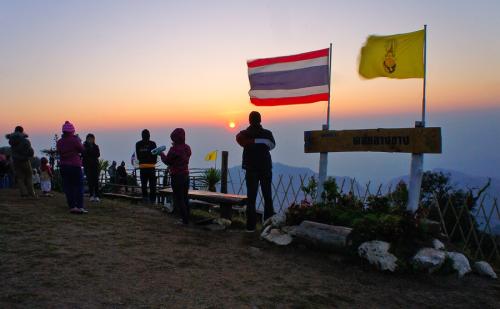
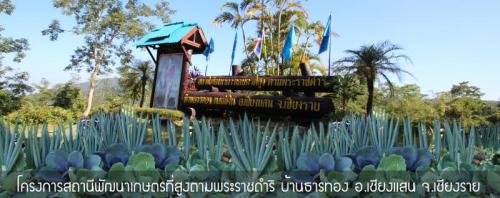
The Royal Agricultural Station Angkhang is an ecotourism site where the nice garden and the interior design are very beautiful and attractive. This is the famous place for tourists to visit and see the cold weather plants and flowers growing. Numbers of tourists visit Doi Angkhang and the Royal Agricultural Station Angkhang, especially in winter.
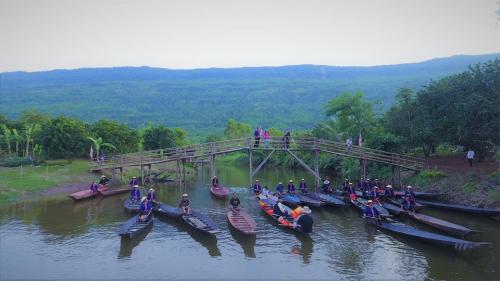
The agricultural tourism is run by the community. There are several activities which are riding tractor to the pier, rowing a boat, seeing the pomelo orchard, learning about planting, tasting the pomelo, eating the local food, watching the shows ,and homestay.
Travel Programs
1. 1 day costs 350 baht per person: welcoming tourists, riding a tractor, riding a boat, enjoying the nature, visiting pomelo orchard, having meals, buying orchard products, sending tourists back
2. 2 days 1 night costs 990 baht per person:
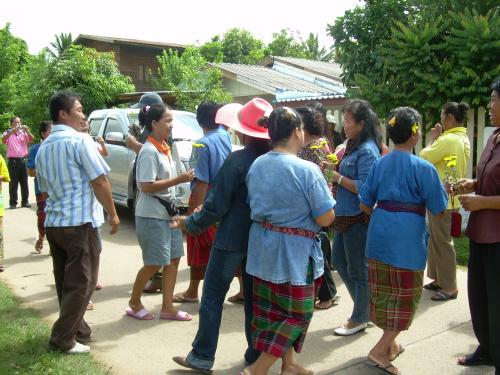
The first day: welcoming tourists, guiding to the agricultural tourism learning center, having dinner at visitor reception center, attending the Bai Sri Su Kwan ceremony, watching the shows of local children, joining activities, and staying at homestay
The second day: having breakfast at visitor reception center, buying souvenirs, and sending tourists back
Other near attractions
1. Hat Nam Phrom - 5 kilometers far
2. Kaeng Tad Sai - 9 kilometers far
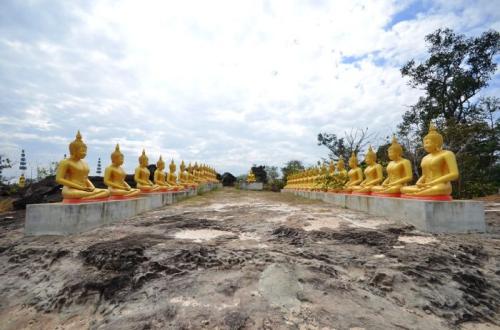
Phu Tham Phra is a large cave, about 3 wa wide, about 8 wa long, located on the southern slope of the mountain. There is an entrance along the rock niche which is majestically located around a tunnel; from the mouth of the cave to the north can walk comfortably. Tham Phra Buddha Cave has 2 levels of nature as a place to be enshrined of Buddha statues, which are lined up in rows and there are 2 reclining Buddha images, Phra Kajjana Buddha images, built during the reign of Ajarn Dee Chano in this beautiful cave
Phu Tham Phra is a small mountainous area. The area is about 200 rai, with mixed deciduous forests that are generally quite complete, providing shady, cool weather. It is the watershed source of many creeks. The stone pillar looks like a tourist attraction of Phu Pha Thoep. And there is a viewpoint as a beautiful natural source near the ascent, there will be a brick arch to be "Phu Ngo", the locals call Khong Gate which is located in the north of Phu Tham Phra, about 1 kilometer away. Currently, only ruins remain.
The sanctity of Phu Tham Phra that has been passed down from generation to generation is that if villagers in that area go out to find forest products; they must come to this cave to worship. Then there will be luck in making a living and escape from all dangers.
1. Methods of organizing activities - Guided tours, cooking and eating Vietnamese food, Wearing Ao Yai (Vietnamese costume), and homestay
2. Community’s way of life - safe vegetable growing local cooking sip local tea
3. Tourist participation – visit vegetable plots Vietnamese food, cycling
Tour Program
Taste local tea, collect vegetables, Vietnamese cooking, Wearing Ao Yai, cycling to see the cultural lifestyle of Thai people of Vietnamese descent, and stay in a homestay
Route links to other attractions (with distance/km)
- Freshwater Fish Museum, a distance of 2 km.
- Chaloem Phrakiat Chakri Dynasty Hall, a distance of 2.5 km.
- Landmark, Phaya Si Sattanakharat, a distance of 5 km.
- The 3rd Thai-Lao Friendship Bridge, a distance of 15 km.
Community enterprise products in the community
Vegetables are safe from toxins, fruit, dried/fresh tea leaves, hammocks, hemp leaf snacks.
Supattra Land Garden is a collection of 25 types of tropical fruit trees such as durian, mangosteen, rambutan, grape, jackfruit, longan, star fruit, coconut, longkong, salaam, dragon fruit, and rose apple. There are many fruits and also hydroponic vegetables and beekeeping.
Baan Bua Thoeng Community, the learning center for sufficient living, mixed farming, organic agriculture, bio-composting resources, the benefits and use of bio-compost to agriculture, and the use of local wisdom in agricultural development to suit hot and dry climate of Northeast.
Nam Dun Thray Dud Miracle pond
Nam Pud upstream forest
Black flowers
Nam Lod Cave
Battlefield historical Cave
Tarn Prueksa Waterfall or Bang Khuy Waterfall
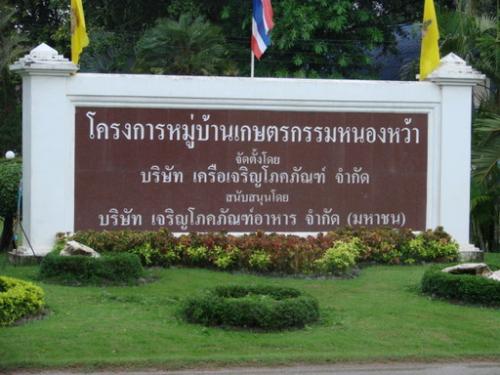
From over 1.6 square kilometer of useless wasteland to a strong farmer community today, “Nong Wa Agricultural Village”, Phanom Sarakham District, Chachoengsao Province uses the “3 Benefit 4 Collaboration” model to enable farmers to access land and funding sources. They revived the dry land to become a green agricultural area, and farmers have a stable career.
The learning center following the footsteps of the Luang Pho Luang is located in Moo 3, Sappaya Sub-district (Huai Krot-Sappaya Road), the Sufficiency Economy Learning Center.